HF Log: a human factors note for every dive
Tl;dr: I made a little app that asks a few questions after a dive and gives you a block of text to paste into the notes in your dive log. The point is to log every dive, including the ones where nothing happened, so that one day we can count near misses properly. You can use it now.
When a dive goes wrong there is a reasonable chance that someone writes it up. DAN collects incident reports, clubs investigate the serious ones, and people like Gareth Lock at The Human Diver have done a lot to get divers talking about the human side of those stories. Almost nobody writes up the dive where nothing went wrong, and without those dives a pile of incident reports can’t be turned into a rate. Aviation and healthcare can work out their rates because their reporting sits on top of a known count of flights or procedures, whereas in diving we mostly have the numerator, and only for the dives that went badly enough for someone to write them up.
For divers to log every dive, an uneventful one has to take a few seconds to record, and an eventful one has to repay the time it takes, mostly by getting you to think about what happened while it is still fresh.
What it does
HF Log is a single page that works on a phone, offline. I try to fill it in as soon as I sit down in my car, while I’m still at the dive site. I usually use voice typing so that cold hands don’t tempt me to be terse; I actually find that thoughts come out much better when I’m rambling.
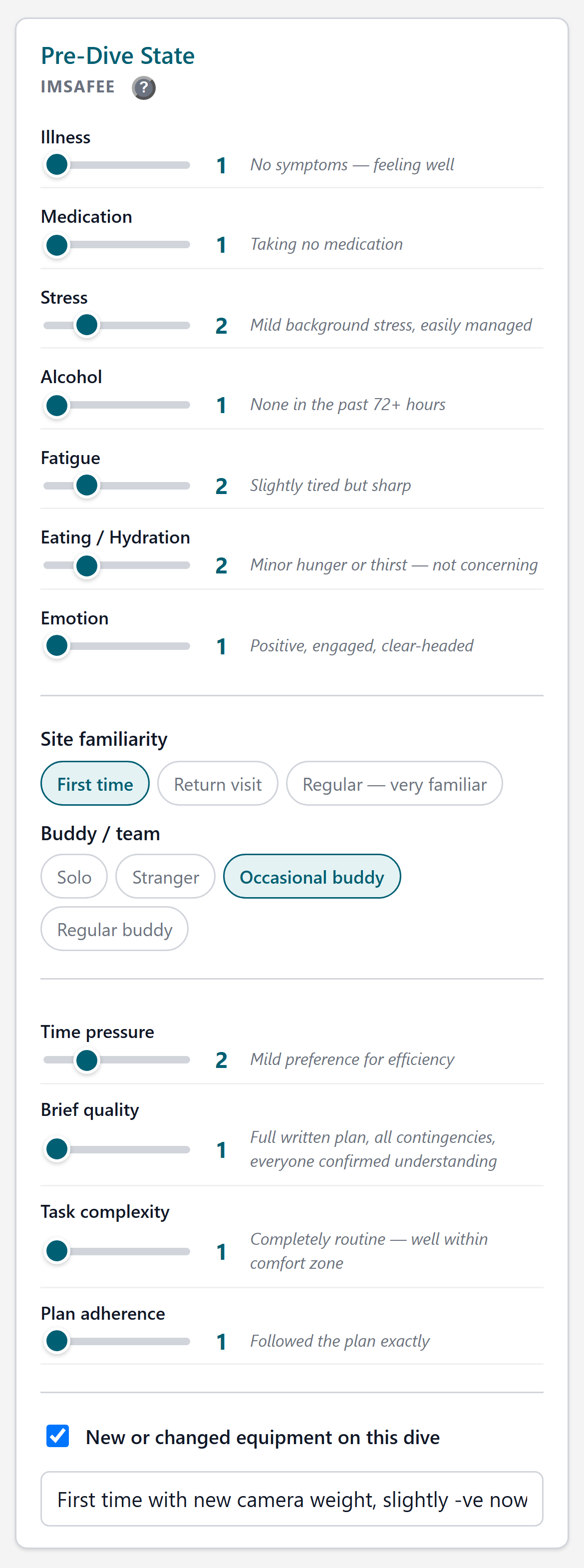
Pre-dive state uses the aviation I’M SAFE check, which I’ve written about in the team simulator guide, with a second E added for Emotion: Illness, Medication, Stress, Alcohol, Fatigue, Eating, Emotion. In aviation it’s a yes/no check; here each item is a slider from 1 to 5, and every value has a short description next to it so that my 3 and your 3 mean roughly the same thing. Alongside that are site familiarity, buddy familiarity, time pressure, how good the brief was, how complex the dive was, how closely you stuck to the plan, and whether you had any new or changed kit.
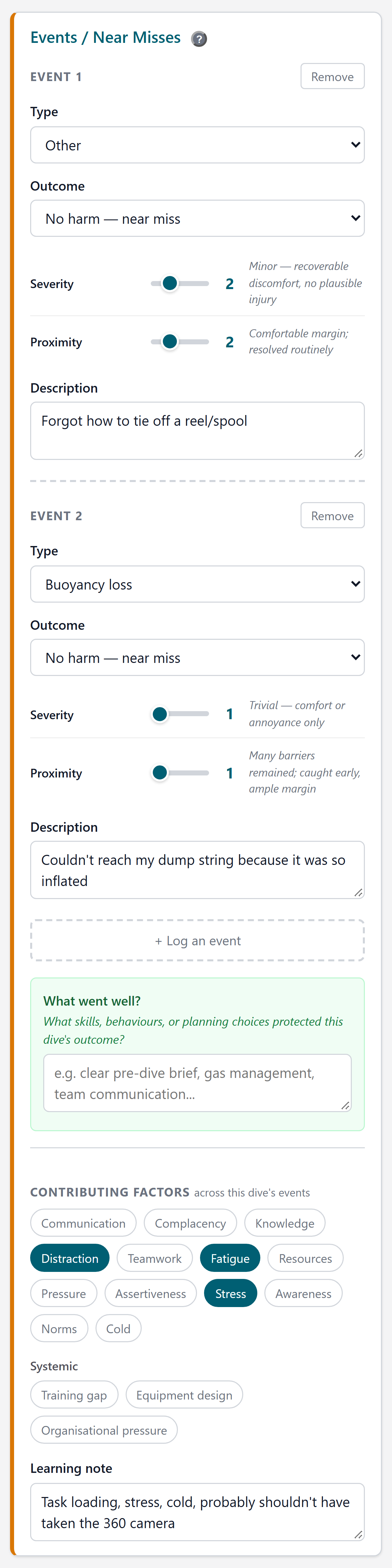
Events can number zero or more per dive. Each gets a type (the list follows DAN’s incident categories, so the data could one day be pooled with theirs), an outcome, a description, and two ratings that are kept apart: severity, meaning how bad it could have been, and proximity, meaning how close it actually came. A single combined score would make a potentially fatal problem caught with plenty of margin (5, 1) look much like a trivial one that only luck stopped (1, 5), although they teach different things, and neither resembles a serious problem that came close (5, 5).
When there are events you can tag contributing factors: the ‘Dirty Dozen’ from aviation maintenance (communication, complacency, distraction, fatigue and so on); Cold, which divers probably need more than mechanics do; and three systemic factors, training gap, equipment design and organisational pressure. The Dirty Dozen all describe the individual, and the systemic tier lets a report point at the course, the kit or the boat schedule instead.
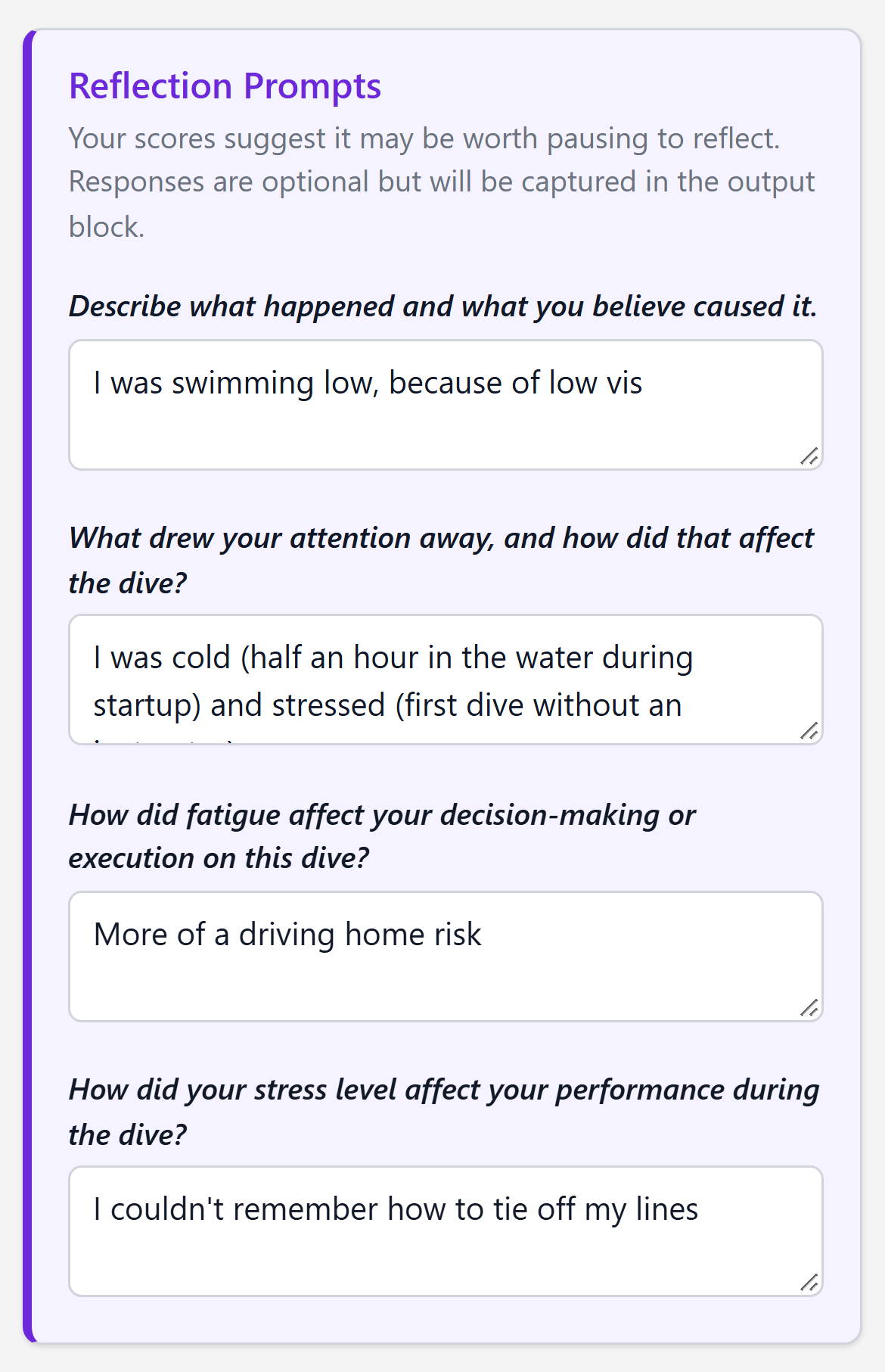
Reflection prompts appear when your answers suggest something is worth thinking about: a high IMSAFEE score, a serious event, a close call, or a particular factor. The app offers up to four questions, so if you lose a guideline it asks about the state of your primary tie-off, and if you tick fatigue it asks how fatigue affected your decisions. Answering is optional. The questions come from a lookup table, which could later be replaced by something that writes questions for the particular dive.
What went well is asked of every dive, eventful or not, because incident data records failures, and the things that protected a dive (a good brief, a buddy who called the turn early, a gas plan with real margin) leave no trace unless someone writes them down.
Where the data goes
There’s no server, account or database. When you’re done, the app gives you a block of text to paste into the notes of that dive in Subsurface or whatever log you use. This one is from one of my dives:
[DIVE-HF v1]
report_id: 0193e9ea-b575-4874-8af5-71422cbab22b
had_event: true
imsafee: {illness: 1, medication: 1, stress: 2, alcohol: 1, fatigue: 2, eating: 2, emotion: 1}
site_familiarity: first_time
buddy_familiarity: occasional
time_pressure: 2
new_kit: "First time with new camera weight, slightly -ve now"
event_count: 2
event_1_type: other
event_1_description: "Forgot how to tie off a reel/spool"
event_1_severity: 2
event_1_proximity: 2
event_1_outcome: no_harm_near_miss
event_2_type: buoyancy_loss
event_2_description: "Couldn't reach my dump string because it was so inflated"
event_2_severity: 1
event_2_proximity: 1
event_2_outcome: no_harm_near_miss
classification: near_miss
factors: [distraction, fatigue, stress]
learning: "Task loading, stress, cold, probably shouldn't have taken the 360 camera"
reflection_1_q: "Describe what happened and what you believe caused it."
reflection_1_a: "I was swimming low, because of low vis"
reflection_2_q: "What drew your attention away, and how did that affect the dive?"
reflection_2_a: "I was cold (half an hour in the water during startup) and stressed (first dive without an instructor)"
reflection_3_q: "How did fatigue affect your decision-making or execution on this dive?"
reflection_3_a: "More of a driving home risk"
reflection_4_q: "How did your stress level affect your performance during the dive?"
reflection_4_a: "I couldn't remember how to tie off my lines"
[/DIVE-HF]
The block is readable by a person and parseable by a program, and it sits alongside whatever else is in the notes. The version number in the first line lets the format change without breaking old records, and pasting a block back into the app refills the form so you can edit it.
Keeping the record in the diver’s own log means the diver holds their data and decides who sees it, and the log software needed no changes because it only carries the text. The block contains nothing that identifies the diver, which suits the kind of reporting it is meant to feed, where reports are confidential rather than anonymous: the organisation running the scheme knows who sent each report but never publishes it, so it can ask the author of a serious or unusually instructive report to get in touch, which an anonymous scheme can’t do.
The app’s subtitle, ‘Normalising the discussion of deviance’, borrows from Diane Vaughan’s study of the Challenger launch decision. She described the normalisation of deviance, in which small departures from the rules become routine because nothing went wrong last time, and talking about those departures while they are still small is the best counter to it that I know of.
How it was built
I started thinking about a Python server, a SQLite database, and a command-line tool that edited Subsurface’s XML files directly. Partway through it became clear that the notes field could do the job of the database, at least for now, and the whole thing shrank into a Svelte app with no back end, hosted on GitHub Pages. It installs to your home screen and works with no signal after the first load.
All the vocabularies (the factor list, event types, slider descriptions and reflection questions) live in one file, because I expect them to change once people who know more than I do have looked at them.
What’s next?
- Somewhere for the blocks to go. At the moment each record lives in one diver’s log. The next stage is a way to collect blocks from many divers (an export from Subsurface, or a submit button in the app), store contact details separately from the reports, and show the numbers that make this worthwhile: near misses per hundred dives, a severity-by-proximity grid, and which factors keep turning up. None of that is built yet.
- Calibration. Turning yes/no checks into 1 to 5 scales gives more detail, but one diver’s 3 won’t be another’s. The descriptions help, and getting a group of divers to rate the same scenarios and compare would help more.
- Users. As far as I know, it’s only been used by me. If you dive, and especially if you’re part of a club or training organisation that already thinks about this, I’d like to hear whether the questions are the right ones, which are missing, and whether you’d actually fill it in after every dive.
The app is at notionparallax.github.io/hflog and the code is on GitHub.